
Essay: Consequentialist Jurisprudence in Utah
Setting aside the increasingly unhinged debate over Prop. 4, an argument on the merits of Judge Gibson's ruling based upon constitutional principles renders her determination as seriously in error.
I understand there have been a lot of unfortunate characterizations, words, and actions here in Utah in response to the district map decision by Judge Gibson. The populist reaction to the ruling has been unhinged, ugly, and inappropriate. But I’m seeing far too many reactions in the other direction, in response to populist rhetoric, that are too built-up in counter-resentment to the resentment. It is my opinion that too many people are failing to consider the matter on the merits.
So, I thought I would lay out the clear constitutional and conservative argument that I have arrived upon against Judge Gibson’s decision, so that hopefully there are fewer traditional conservatives who fall for the trap of standing on what I feel is the wrong side of this issue out of an instinctual opposition to the populists.
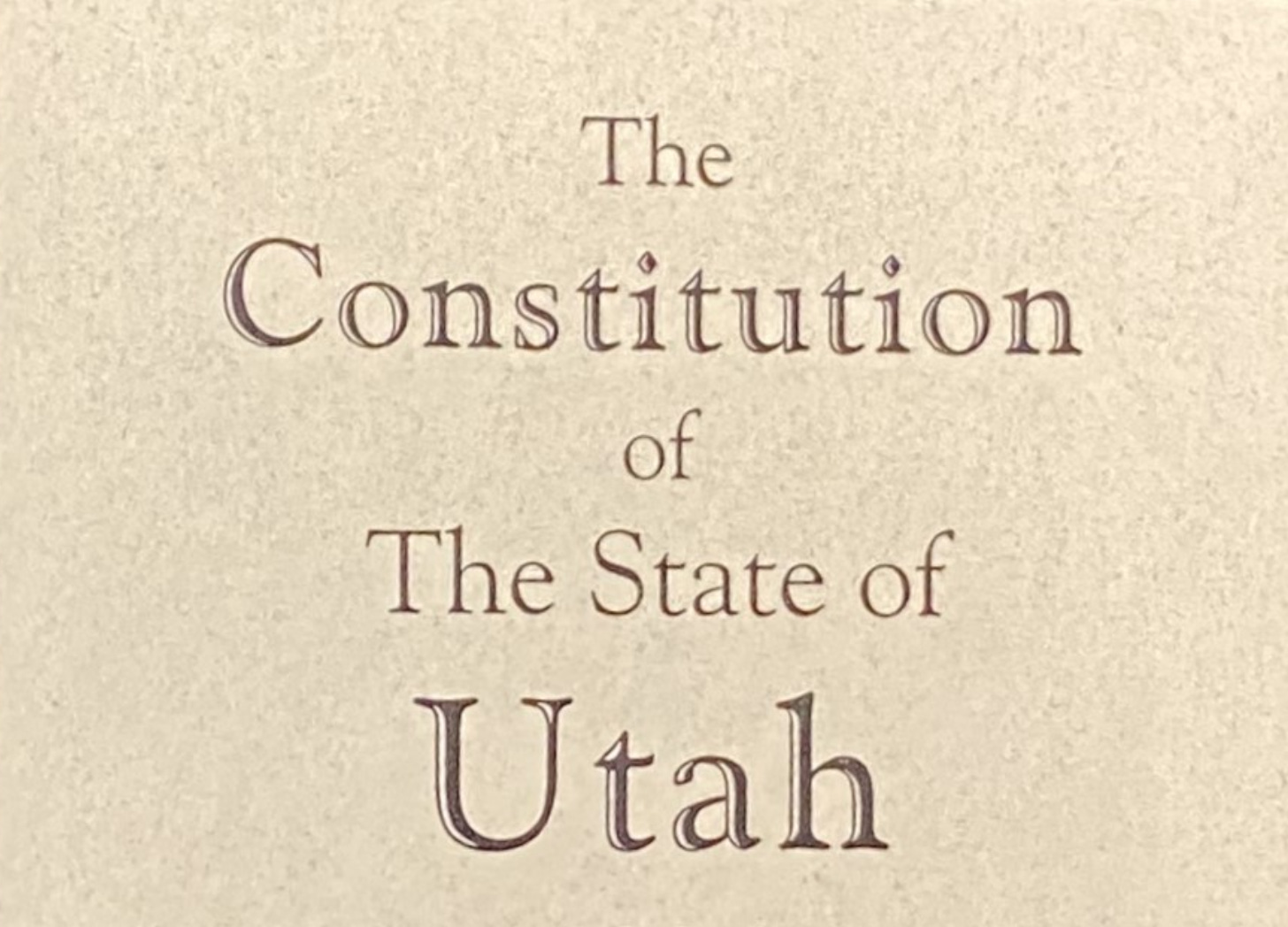
Article IX, Section 1 of the Utah Constitution is clear and straightforward: “...the Legislature shall divide the state into congressional, legislative, and other districts...” This is clear, unequivocal language that grants exclusive authority and power for creating the district map to the state legislature.
This constitutional provision reflects the principle of constitutional theory that in establishing a constitution, the people delegate authority to the legislature to create and establish the law. While there is a disagreement among constitutional theorists as to the right of the legislature to further delegate authority to other entities, it is generally agreed that legislative power should remain ultimately answerable to legislative authority. When a State Constitution specifically establishes who shall exercise a specific power, that power must remain answerable to the entity granted that power.
Any law under a constitution that attempts to shift that power to another authority is null and void under constitutional law. The only way to alter the specific vesting of any power within a constitutional framework is to directly amend the constitution itself.
Proposition 4 was already tenuous on constitutional grounds and only allowable under the terms of the Utah Constitution because the final decision on the district map remained with the state legislature. Proposition 4 was not a constitutional amendment. It did nothing to amend, alter, or reallocate the power and authority granted to the legislature to create the district map under the Utah Constitution.
Proposition 4 did nothing more and nothing less than establish a commission to recommend district maps for consideration by the state legislature and create a structure of certain basic requirements under which suits could be filed to block the implementation of an adopted district map that claimants argue violates those basic requirements.
Proposition 4 does not transfer the constitutionally delegated power to make the final determination on a district map to the commission, nor does it establish a new power in the judiciary to implement an alternate map from the commission that the legislature has not chosen. The only authority the commission has under Proposition 4 is to recommend maps. The only authority the judiciary has under Proposition 4 is to block the implementation of a map. If Proposition 4 had done anything other than establish a recommendation power and a blocking power, the law would have been unconstitutional.
Based upon these stubborn facts, there are only two ways to understand Judge Gibson’s decision. By assuming the power to choose the district map herself she either 1) essentially confessed that Proposition 4 is unconstitutional in contrast to the clear provision in Article IX, Section 1 of the Utah Constitution or 2) chose to exercise a consequentialist form of jurisprudence that placed her opinion that the Democratic Party deserved an uncontested district over a consideration of the original and textual interpretation of the Utah Constitution.
Regardless of any other argument over the nature or merits of Proposition 4 or the behavior of the Utah legislature as it navigated the provisions of Proposition 4, an originalist and textual interpretation of Article IX, Section 1 demands that if Judge Gibson determined the map put forward by the Utah Legislature violated the law, it was her duty to return the question to the State Legislature to try again, to do nothing more than block the district map she deemed in violation of the law. She should not have assumed for herself a power to choose the district map herself when the Utah Constitution clearly vests that power in the State Legislature and the State Legislature alone.
Judge Gibson exercised power she does not have. She rendered a determination that was a policy outcome rather than a judgement upon the lawfulness of a policy put forward by the legislature. That is not the role of a judge, nor does such a role fall under the powers granted to the judiciary under the Utah Constitution.
As a conservative, I believe in the sanctity of proper process and on any matter would prefer a poor outcome under proper process than an outcome I prefer through an improper process. As a constitutional scholar, I am very much an admirer of Antonin Scalia and his jurisprudential philosophy.
In this circumstance, I believe Scalia would chide Judge Gibson for straying from the sole duty of a judge to render judgement. He would argue that it is not the role of the judge to determine if a law or a policy under the law was a good law or a bad law, but whether it was constitutional and appropriate under the text and history of the relevant law and constitutional provisions. And he would argue it is never the role of the judge to wrest away the creation of law or the creation of policy from the legislative branch. If it is the determination of a judge that a law is unconstitutional or a policy is unlawful, Scalia would say that the sole duty of the judge is to “return to sender,” to tell the legislature to do their job and refuse to do their job for them.
Now, Judge Gibson’s counter-argument to all of this is that “While a state court’s role in redistricting is new to Utah, this judicial function is neither new nor novel. It is well settled that when the political branches fail to enact lawful electoral maps, the judiciary’s duty to provide an effective remedy is not discretionary.” She pointed to a similar exercise of power in other states where courts selected remedial district maps when the map proposed by a legislature was found in violation of standing law. Because of this court precedent and due to the timing of the matter under question, she felt that the courts “have a fundamental obligation to uphold constitutional rights and to ensure a lawful electoral map is in place.”
The problem I find in Judge Gibson’s reasoning is two-fold.
First, she confesses that there is no relevant precedent for a court’s role in the redistricting process under Utah law but claims to find such a precedent in the proceedings of courts in other states. Under the sovereignty granted to each state under the U.S. Constitution, this claim of court precedent simply makes no sense.
No two state constitutions in America are alike, and each state constitution creates completely different provisions, powers, and processes. Legal precedent created under other state constitutions should have no relevance whatsoever in the determinations of courts under the Utah Constitution, no matter how similar the facts of cases may be. The wording of the relevant Constitutional provisions and the relevant state laws would have to be virtually verbatim to justify the use of court precedent from one state in the consideration of a novel question in another state.
The only relevant precedent to a court proceeding in Utah are those established under the Utah Constitution and those established under the Federal Constitution. And if the Federal Constitution was silent and failed to render court authority over the redistricting process in Utah before Proposition 4, nothing has changed after the adoption of Proposition 4. Therefore there is no relevant precedent a judge can credibly call upon that justifies the exercise of power that, yes, under the Utah Constitution and in Utah jurisprudence is, in fact, new and novel.
Based upon the dual sovereignty created by the U.S. Constitution, only the supremacy clause limits the power of states. Except in their relationship to the Constitution, according to the provisions of the constitution that dictate certain aspects of state relations, and under the laws established by Congress states are independent entities from one another. For a judiciary in one state to assume a novel power under its constitutional law based upon the judicial precedent in another state under the auspices of a different constitutional law is no different than if the Supreme Court claimed a power for itself based upon a judicial precedent in Germany, or Great Britain, or France.
Courts, of course, are well within their rights to consider the solutions rendered by courts in other jurisdictions as illuminating or informative in seeking solutions in their own proceedings. But that is very different than claiming judgements rendered under different constitutional realities as precedent, let alone relying upon that precedent to create a novel power in its own and separate constitutional reality.
As for my second disagreement with Judge Gibson’s defense of her actions, she relies upon pure consequentialist reasoning to claim the power to select the district map instead of simply to reject the district map chosen by the legislature. She points to the need to have a district map appropriate under the provisions of Proposition 4 in time to conduct the 2026 election utilizing that map. She argues that if she did not exercise this power, “the right to vote could be rendered illusory and the constitutional guarantee of free and lawful elections would go unfulfilled.” She assumes the mantle of defender of fundamental freedoms and the existence of free and fair elections to justify choosing the district map herself.
The problem with this argument is that the state legislature had already exercised its authority to draw a new district map in 2020, and the right to vote was fully exercised and free and lawful elections were duly carried out under the legislature’s 2020 district map. It was the provisions of new law under Proposition 4 that led to the requirement of the legislature to draw up a new district map, under court order, and it was Judge Gibson’s own ruling under the provisions of Proposition 4 that led her to reject the map the legislature had chosen in their attempt to comply with the provisions of Proposition 4. The right to vote in Utah and the guarantee of free and lawful elections had never been under question. Not until, apparently in Judge Gibson’s view, Proposition 4 forced the legislature to redraw the district map.
The question placed before Judge Gibson was whether the map presented to her, chosen according to Section IX Article 1 of the Utah Constitution by the state legislature, complied with the provisions of Proposition 4. And Proposition 4 was a measure to avoid gerrymandering in the legislature’s process of creating a district map. No one ever claimed in Judge Gibson’s court that adherence to the provisions of Proposition 4 were necessary to follow in order to safeguard the right to vote or guarantee free and lawful elections. Such a claim would essentially assert that every election conducted before the introduction of Proposition 4 in the history of Utah violated the right to vote and failed to provide a free and lawful election.
What Judge Gibson did was provide an extraordinary remedy in a conflict between statutory and constitutional law that chose to argue that the provisions of the statutory law were so necessary to the maintenance of free and lawful elections that they must be upheld over the clear provisions of constitutional law. She claimed a right to survey all the maps submitted to the legislature by the commission and choose a map she determined best fit the provisions of Proposition 4, even though the legislature had only chosen one of those maps.
Even if Judge Gibson felt the timing of the question dictated that a district map had to be chosen immediately to avoid disruption of the electoral process, even if she felt there was no longer time to remand the selection of a district map back to the legislature without bringing into question the right to vote in a free and lawful election, she still had no authority under the Utah Constitution to wrest power away from the legislature. There is no consequentialist argument that can justify placing the provisions of statutory law over the provisions of constitutional law.
The only lawful remedy available to Judge Gibson that balanced the provisions of the statutory law under the clear provisions of the constitutional law, if she absolutely found it necessary to choose a district map herself rather than return the question to the legislature, was to choose a district map from among those approved by the legislature since the last census that best reflected the provisions of Proposition 4 for use in the upcoming election and then return the question to the legislature to continue its efforts to better meet the standards of Proposition 4 by creating a new district map for use in future elections.
I’m sure the arguments against this ruling from proponents of Proposition 4 is that such an outcome provides a way for the legislature to dodge the provisions of Proposition 4 by continuing to offer the same or similar maps for consideration, weathering the courts rejection, and hoping for a similar remedy in the next election to avoid having to be constrained by the provisions of Proposition 4. And that’s true, such a ruling does create that possibility.
However, such a consequence of a proper, constitutional ruling does not change the reality of what the Utah Constitution says. It is the duty of the courts to uphold statutory law in a way that best allows its provisions to go into effect without violating the constitutional law. If the outcome of such a ruling is that the statutory law fails to accomplish its goal, then that suggests either that the preferred outcome is impossible to obtain without changing the constitutional law or the statutory law needs to be fixed to better accomplish its design. It is not the role of a judge to guarantee the preferred outcome of those who crafted a statutory law and it is a violation of a judge’s oath of office to assail the constitutional law in order to provide the reality a statutory law attempts to create.
I frankly feel there is very little credible defense of the jurisprudence of Judge Gibson. This whole affair provides a perfect example of the failures of consequentialist jurisprudence when compared to the value of originalist and textualist jurisprudence.
I find many of the proposed remedies of the opponents of Judge Gibson’s decision equally distasteful to her ruling, especially the court packing schemes being suggested in Utah in order to immediately fill the courts with more originalist and textualist judges. I will always be against expansions of the courts to obtain preferred outcomes.
However, I think both the efforts to repeal Proposition 4 and the suggestion that perhaps Judge Gibson should undergo impeachment proceedings in consequence of her ruling as ideas that should definitely be taken under advisement.
On the question of repealing Proposition 4, I think even its proponents should recognize at this point that all they’ve accomplished is to hopelessly complicate the process of selecting a district map. The law itself, not only the legislature, has derailed the timely establishment of a district map for an up and coming election. Utah has never had a problem establishing a district map in time for an election until the introduction of Proposition 4. Gerrymandering may be a legitimate concern, but as Judge Gibson herself argues, a failure to select a district map in a timely matter could render the right to vote illusory and fail to fulfill the “constitutional guarantee of free and lawful elections.”
Gerrymandering is definitely an issue for which we should seek solutions, but it is an issue that has been with us since the beginning of the American Republic. It is not an issue of such momentous concern that the right to vote and the guarantee of free and fair elections should be brought into question thanks to the a complicated process introduced by a new, untested law. This whole affair should be a signal to everyone that it’s time to go back to the drawing board in Utah.
But even worse than complicate the process, Proposition 4 has brought into question whose power it is to choose the district map in Utah. Is it the legislature, is it the commission, or is it the judiciary? The Constitution says it is the legislature. But Judge Gibson’s ruling suggests that the courts have the authority to choose from among the maps created by the commission if the legislature fails to select an appropriate map from among those presented by the commission, even though Proposition 4 itself creates no such power or process, only the authority of the courts to block the implementation of a map.
Would Utah voters have approved Proposition 4 if they understood that its provisions would wrest the power away from their representatives to choose the district map and give that power to a commission and a judge who are not directly answerable to the people for their selection? I tend not to think so.
As to the question of impeachment, I understand and understand well the concerns that an unwarranted impeachment calls into the question the independence of the judiciary, and that judges should be able to render judgement on the law without fear of political consequence if their judgement is unpopular.
But at the same time, impeachment is the only remedy, the only check and balance, available to the legislature and to the people in response to a judgement that seems to fly in the face of constitutional law and the separation of powers. If the legislature should be overly cautious in the exercise of its impeachment power for fear of threatening the independent exercise of the power granted to the judiciary under the Utah Constitution, why weren’t the courts in this specific circumstance equally cautious in the exercise of its judicial power for fear of threatening the independent exercise of the power granted to the legislature under the Utah Constitution?
As I wrote about impeachment last week, I feel we have limited the exercise of the impeachment power by legislative power to an extreme degree compared to how the power was envisioned by the founders, while vastly extending the exercise of judicial and executive power far beyond what was envisioned by the founders. No one is concerned about the independence of legislatures when executives exercise the veto power beyond the original intent of the power to reject unconstitutional law, not laws the executive simply disagrees with. No one is concerned about the independence of legislatures when the exercise of judicial review goes beyond the original intent of the power to render judgement in the constitutionality of the law and the faithful execution of the law, not to dictate policy outcomes or consider the consequence of law rather than the text of the law.
It simply doesn’t make sense to me to worry about giving back a little more power to the branch of government at both the state and federal level that modern developments has rendered the weakest of the three…when the constitutional design intended that branch to be the strongest. And I don’t comprehend the panicked response to the idea of humbling the branches of government that have grown far more powerful than the legislative branch.
Regardless, the impeachment process is intended to provide one of two outcomes, the removal of a public officer who has lost the public trust or the restoration of public trust. It is not a process that inherently attacks and destroys the independence of the executive or the judiciary.
A removal of a public officer restores the trust and independence of a branch of government just as the removal of a tumor restores the health and constitution of a human body. And a public officer who survives the impeachment process walks away with even more credibility and independence than before their faithfulness was brought into question. The impeachment process is a restorative process, not a destructive one.
However things play out in Utah, I again reiterate that this affair is a clear demonstration of the poor jurisprudential merits of consequentialism. Originalism and textualism are the more proper jurisprudential philosophies for the maintenance of a constitutional republic. And I hope that the arguments I have made in this essay provide for a better rebuttal of Judge Gibson’s determinations than that which we have seen coming from populists in Utah. And I hope that there are fewer individuals in good faith who are defending Judge Gibson and her jurisprudence in reaction to the angry populist outcry.
My opinion, of course, is not the only opinion. But I tend to think its a good opinion. And I hope you will consider what I’ve had to say as you consider this issue on the merits, rather than on a preference and instinct to be on the opposite side of the issue from your typical political opponents.